



 Add a button link here


Listen to this article:
Introduction
The EU Pay Transparency Directive takes effect in less than six months. Yet, many HR leaders don't know the exact deadlines, which countries have transposed the law, or what penalties they face for non-compliance.
The stakes are high. Miss the 7 June 2026 deadline, and your organization risks regulatory fines, employee compensation claims, and exclusion from public contracts.
This article gives you everything you need to prepare. You'll find the complete timeline from 2023 to 2031, a country-by-country transposition tracker with official government sources, deadline breakdowns by company size, and a 6-month compliance checklist covering January through June 2026.
For a complete overview of the directive's requirements, see our EU Pay Transparency Directive: Complete Guide.
Let's start with the key dates every HR and compliance team needs to know.
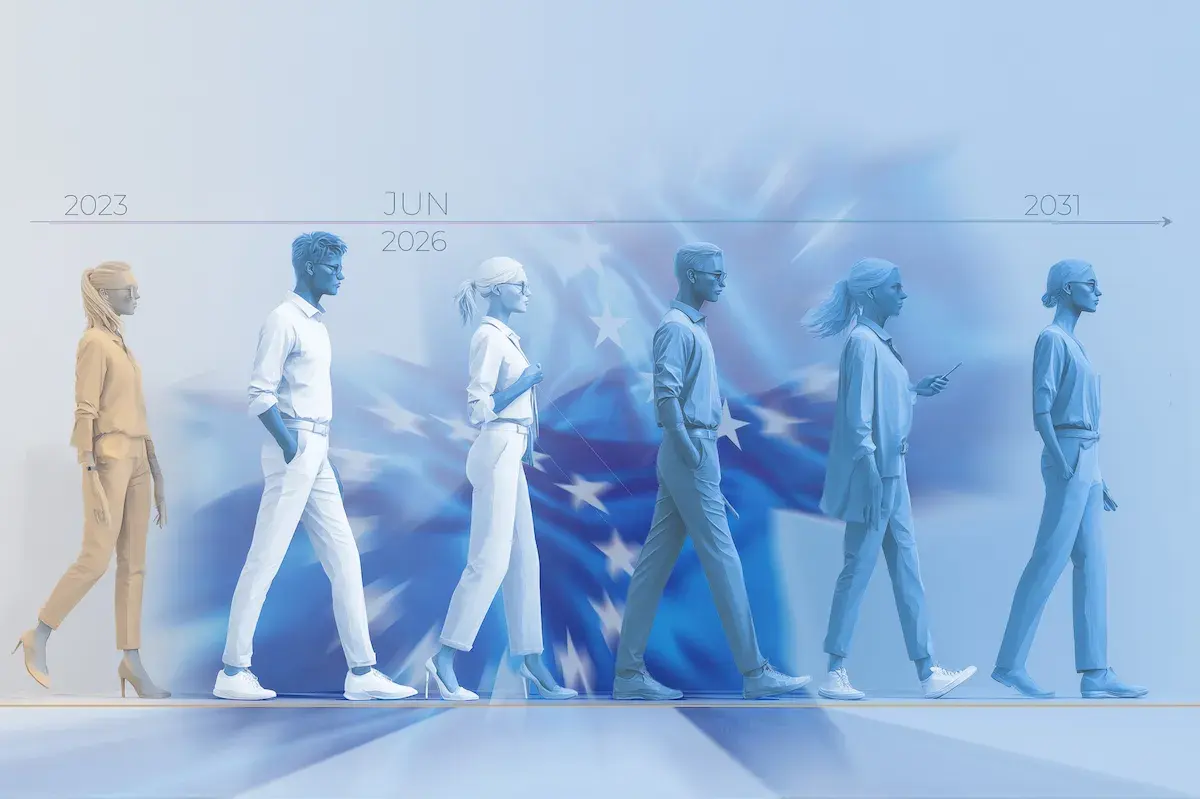
The master timeline: 2023 to 2031
The directive follows a phased implementation schedule. Understanding these dates helps you work backwards from your specific obligations and set realistic internal milestones.
Missing a deadline doesn't just mean regulatory penalties. It means your pay gaps become public before you've had time to address them. It means facing discrimination claims with the burden of proof on your shoulders. The companies that start early will have time to identify issues and fix them quietly. Those who wait will be doing damage control in public.
Here are the milestones that matter:
May 2023: Directive adopted
The EU Pay Transparency Directive (2023/970) was published on 17 May 2023. It entered into force on 6 June 2023, twenty days after publication. This started the three-year countdown for EU member states to transpose the directive into their national laws.
The directive establishes minimum requirements. Member states can go further, and some, like Sweden, already have.
June 2026: National laws take effect
By 7 June 2026, all 27 EU member states must have binding national legislation in place. This is the critical date for employers.
From this point forward, transparency obligations become legally enforceable. Employers must include salary ranges in job postings or provide them before interviews. Employers can’t ask candidates about their salary history. Employees can request pay information, and employers must respond within two months. All pay decisions must be based on objective, gender-neutral criteria.
These requirements apply to all employers, regardless of company size.
June 2027: First reports due
Companies with 150 or more employees must submit their first gender pay gap reports by 7 June 2027. These reports will cover payroll data for the 2026 calendar year.
This means the data you collect starting in June 2026 will form the basis of your first public report. Any gaps that exist when the directive takes effect will be visible. Companies with 250+ employees will report annually thereafter. Companies with 150-249 employees will report every three years.
June 2031: Full rollout
Companies with 100-149 employees must submit their first gender pay gap reports by 7 June 2031. These reports will cover payroll data for the 2030 calendar year. After this date, all companies with 100+ employees will be subject to regular three-year reporting cycles.
Sweden's existing Discrimination Act already requires employers with just 10 employees to conduct annual pay surveys, and the draft legislation proposes maintaining this requirement.
Where should you be right now?
If you're reading this in early 2026, you should have already completed (or be close to completing) a pay equity audit. You should know where your gaps are and have a remediation plan in place.
The next six months should focus on four priorities:
- Update your recruitment policies to include salary ranges and remove salary history questions.
- Test your HRIS and payroll systems to ensure they can generate the required reports.
- Train hiring managers and HR teams on new requirements.
- Communicate changes to employees before the directive takes effect.
If you haven't started preparing, you're behind, but it's not too late. The 6-month compliance checklist later in this article will help you prioritize the most critical actions. Focus on the audit first. You can't fix what you haven't measured.
Where does your country stand? Transposition tracker
National transposition is the process by which member states incorporate EU directives into domestic law. The directive sets minimum requirements, but each country implements it differently.
According to the official EUR-Lex transposition tracker, only Belgium and Czechia have formally notified the European Commission about implementing measures, and Belgium's notification covers only a partial French Community decree.
Here's the current status across all 27 EU member states, based on official government sources.
Countries with legislation in progress
Only one country has completed a full draft law. Sweden published its 388-page proposal (SOU 2024:40) in May 2024, making it the most advanced in the EU. Three countries have enacted partial transpositions, covering some but not all of the directive's requirements. Another three have drafts under consultation or delegation laws adopted.
Countries in active preparation
These countries have confirmed they are working on transposition but have not published draft legislation. Progress ranges from formal working groups to parliamentary inquiries.
Countries with pre-existing legislation
Three countries already have pay transparency frameworks that partially address directive requirements. They will need to fill gaps rather than build from scratch.
Countries with no documented action
Nine countries show no publicly accessible transposition documentation as of December 2025.
Given the directive's complexity and the limited progress in many member states, infringement proceedings by the European Commission appear likely for countries that fail to meet the June 2026 deadline.
What if your country hasn't transposed yet?
The lack of national legislation doesn't mean you can wait. Prepare based on the EU directive's minimum requirements; these will apply regardless of national variations. Most countries that miss the deadline will eventually implement requirements close to the EU baseline.
Monitor your country's labor ministry website for updates. When legislation is published, review it for any provisions stricter than the EU minimum and adjust your compliance plan accordingly. Companies that wait risk running out of time for implementation entirely.
This section is updated monthly. Last update: January 2026. Source: Official government portals and EUR-Lex National Transposition Measures.
Deadlines by company size
Not every company faces the same timeline. Your reporting obligations depend on how many employees your EU company has.
The gender pay gap across the EU stands at approximately 12-13%. This directive aims to reduce and ultimately close that gap through mandatory transparency and reporting. Understanding your specific deadlines helps you plan accordingly.
6-month compliance checklist: January to June 2026
This checklist provides a month-by-month roadmap to reach compliance by 7 June 2026. Each month focuses on a specific area, with concrete tasks and warnings about common pitfalls.
Use this as a working document. Assign owners, set due dates, and track progress in your regular HR meetings.
1. January 2026: Complete your pay equity audit
Objective: Understand your current pay landscape
Your pay equity audit is the foundation of everything else. You need to know where gaps exist before you can address them.
Action items:
✅ Gather comprehensive compensation data across all EU entities
✅ Identify gender pay gaps by worker category (same work or work of equal value)
✅ Flag all gaps exceeding the 5% threshold and document justifications
✅ Brief leadership on audit findings and recommended next steps
Watch out: Pay gaps that remain unresolved when the directive takes effect will appear in your first public report. If you have gaps exceeding 5% that you can’t objectively justify, you'll also be required to conduct a joint pay assessment with worker representatives. We recommend addressing issues now while you still have time.
2. February 2026: Update recruitment and pay policies
Objective: Align hiring practices with pre-employment transparency requirements
The directive changes how you recruit. Employers must provide salary information to candidates before interviews or contract signing. You can no longer ask about salary history. All pay decisions must be based on documented, objective criteria.
Action items:
✅ Create salary range templates for all job postings
✅ Update job posting templates with gender-neutral language
✅ Remove salary history questions from your interview process
✅ Document pay criteria and progression policies in accessible formats
Watch out: Some countries are already enforcing these requirements (for example, Poland and Malta). If you're hiring in these countries, you should already be compliant.
3. March 2026: Train your team and test systems
Objective: Prepare your people and HR technology for compliance
Policies on paper mean nothing if your hiring managers still ask about salary history or your HRIS can't generate the required reports. This month focuses on operationalizing your compliance program.
Action items:
✅ Train hiring managers on new recruitment requirements
✅ Train HR team on handling employee pay information requests
✅ Test your HRIS/payroll system's ability to generate required metrics
✅ Establish a documented process for responding to information requests
Watch out: The directive requires employers to respond to pay information requests within two months. If you don't have a process in place, you risk non-compliance the moment an employee submits a request after June 2026. Build and test your response workflow now.
4. April 2026: Dry-run reporting and employee communication
Objective: Test your reporting and communicate changes to your workforce
A dry-run report using 2025 data will indicate whether your systems can correctly calculate the required metrics. This is also the time to communicate proactively with employees about what's changing and why.
Action items:
✅ Generate a practice gender pay gap report using 2025 payroll data
✅ Validate that all required metrics can be calculated correctly
✅ Launch an employee communication campaign about pay transparency changes
✅ Hold a town hall or Q&A session to address employee questions
Watch out: A dry-run report often reveals issues you didn't catch in your audit. If you find significant problems, you still have two months to address them before the deadline.
5. May 2026: Final reviews and legal sign-off
Objective: Final compliance check and documentation
With one month to go, this is your final review. Legal should sign off on all updated policies. Confirm that any country-specific requirements are addressed.
Action items:
✅ Complete legal review of all updated policies and procedures
✅ Verify country-specific requirements are addressed
✅ Finalize job classification and pay structure documentation
✅ Obtain executive sign-off on compliance readiness
Watch out: National laws may have variations from the EU directive. If your country has only recently published its final legislation, this is your last chance to incorporate any surprises.
6. June 2026: Compliance month
Objective: Launch compliant practices and begin tracking for your first report
On 7 June 2026, the directive becomes enforceable across the EU. Your transparency obligations are now live. Begin tracking the 2026 payroll data that will form the basis of your first report.
Action items:
✅ Confirm all job postings include salary ranges by 7 June
✅ Activate your process for handling employee pay information requests
✅ Begin tracking 2026 payroll data for your June 2027 report
Success: You're now operating under the EU Pay Transparency Directive. For companies with 150+ employees, your next major milestone is submitting your first gender pay gap report by June 2027.
What happens if you miss deadlines?
Missing the June 2026 deadline isn't just a compliance problem. It's a business risk that compounds over time. The directive creates multiple enforcement mechanisms that work together to make non-compliance increasingly costly.
Financial penalties
The directive specifies that penalties must include fines. Most countries haven’t published their penalty structures yet, and where penalties have been announced, they vary significantly. Some countries may impose per-violation fines. Others may calculate penalties based on company revenue or the number of affected employees.
Shifted the burden of proof
This is the most significant enforcement change. Under the directive, if an employee claims pay discrimination, the burden of proof shifts to the employer. The employee doesn't need to prove discrimination. Employers need to prove their absence. And without documented, objective pay criteria and transparent structures, employers have no evidence to present.
Uncapped compensation claims
Employees who experience pay discrimination are entitled to full compensation under the EU directive. This includes back pay, bonuses, and payments in kind. It also includes compensation for lost opportunities and non-material damage.
Unlike administrative fines, there's no cap on what employers might owe. A pattern of underpayment across multiple employees over several years can result in substantial liability. One successful claim can trigger others, as employees compare notes and discover similar discrepancies.
Public procurement exclusion
Non-compliant employers may be excluded from public procurement procedures. If your business relies on government contracts, this could have serious commercial consequences beyond any fines. Some member states may make compliance a mandatory criterion for public tenders.
Reputational damage
Non-compliance and pay gaps are publicly disclosed. Gender pay gap reports will be available to employees, candidates, investors, and the public. In an era of employer review sites and social media, the reputational cost of being seen as a non-compliant or unfair employer can affect your ability to attract talent for years.
How to set internal milestones
The checklist above gives you month-by-month guidance through June 2026. But compliance doesn't end there. Setting internal milestones helps you maintain momentum, track progress, and ensure nothing falls through the cracks.
1. Work backwards from your reporting deadline
If you're a company with 150+ employees, your first report is due June 2027. Work backwards to set internal deadlines. January through March 2027 should focus on compiling 2026 data, calculating metrics, and preparing your report. April and May are for internal review, legal sign-off, and worker representative consultation. June is submission. Build these milestones into your HR calendar.
2. Assign clear owners
Each workstream needs an accountable owner. Your compensation or total rewards lead should own the pay equity analysis. HR operations should own policy updates. Your HRIS or people analytics team should own systems and reporting. Legal counsel (internal or external) should own the compliance review.
3. Establish review cadence
During the final six months before June 2026, consider weekly check-ins on compliance progress. A short standing meeting keeps the work visible and surfaces blockers early. After go-live, shift to monthly reviews of pay transparency metrics and quarterly reviews of overall compliance posture.
Your review cadence should match your risk. Companies with large EU workforces or complex pay structures may need more frequent check-ins. Smaller organizations with simpler structures can review less often.
4. Integrate with performance management
Your performance management cycle directly affects pay decisions. Performance criteria must be objective and documented. Pay progression must be tied to transparent criteria. Managers must be trained to make and explain pay decisions.
If your performance management system relies on subjective assessments or undocumented criteria, you'll struggle to justify pay differences when employees ask.
This is exactly where EU pay transparency compliance software becomes essential, helping organizations align performance and compensation processes before the directive takes effect.
Align your performance and compensation processes before the directive takes effect.
The companies that succeed with pay transparency will be those that embed it into their regular HR rhythms. It's not a project with an end date. It's a new way of operating.
Wrapping up
The EU Pay Transparency Directive represents the most significant shift in pay equity regulation in decades. With less than six months until the June 2026 deadline, the time to act is now.
Key dates to remember:
- 7 June 2026: National laws take effect across all EU member states
- 7 June 2027: First gender pay gap reports due for companies with 150+ employees
- 7 June 2031: First reports due for companies with 100-149 employees
For HR teams and compliance leaders, even if your country hasn't finalized its legislation, preparing based on the EU directive's requirements will put you in a strong position to adapt quickly.
Use the month-by-month checklist in this article to structure your remaining preparation. Start with the pay equity audit if you haven't already. You can't fix what you haven't measured.
This article will be updated as member states publish new legislation and as the June 2026 deadline approaches. Check back for the latest transposition status and compliance guidance.
This article is for informational purposes only and does not constitute legal advice. Organizations should consult with legal counsel regarding specific compliance requirements in their jurisdiction.
Country transposition status last updated: January 2026
Frequently asked questions
-
What if my country hasn't transposed the directive yet?

-
Which year's data do I report on first?
-
What's the deadline for responding to employee pay information requests?
-
Do companies with fewer than 100 employees need to do anything?
-
Can we still negotiate salaries?
-
What if our pay gap exceeds 5%?
Prepare based on the EU directive's minimum requirements, which will apply regardless of national variations. Most countries that haven't transposed yet are expected to implement requirements close to the EU baseline. When your country publishes its legislation, review it for any stricter provisions and adjust your approach accordingly.
For the June 2027 reporting deadline, you'll report on calendar year 2026 payroll data. This is why it's critical to have your systems and categorizations in place by June 2026. You'll be tracking from day one of the compliance period. The Netherlands is an exception: it has delayed implementation to January 2027, meaning employers there will first report on 2027 data.
Employers must provide requested pay information within two months of the request. The information should include average pay levels broken down by sex for workers performing the same work or work of equal value. You can’t charge employees for this information or penalize them for requesting it.
Yes. While you're exempt from gender pay gap reporting, you must still comply with all transparency measures. This means including salary ranges in job postings or providing them before interviews, not asking candidates about salary history, responding to employee pay information requests within two months, and using objective criteria for all pay decisions.
Yes. The directive requires transparency, not rigid pay scales. Both employers and candidates can still negotiate, and negotiated outcomes can fall outside the disclosed range if justified by objective criteria. Transparency simply means candidates know the starting point before negotiations begin.
If your reported pay gap exceeds 5% in any category of workers and you can’t justify it with objective, gender-neutral criteria, you must conduct a joint pay assessment with worker representatives. This assessment identifies root causes and develops corrective measures. You have six months to remedy unjustified gaps before a joint assessment becomes mandatory.




-1.png)