


Listen to this article:
What happens when HR stops being a support function and becomes a system layer that connects admin, performance, contracts, integrations, and culture?
At Lowe Group Romania, the shift didn’t start with a big transformation plan but with a simple question: what if there were one place that could cover the entire employee experience, from hiring to retiring?
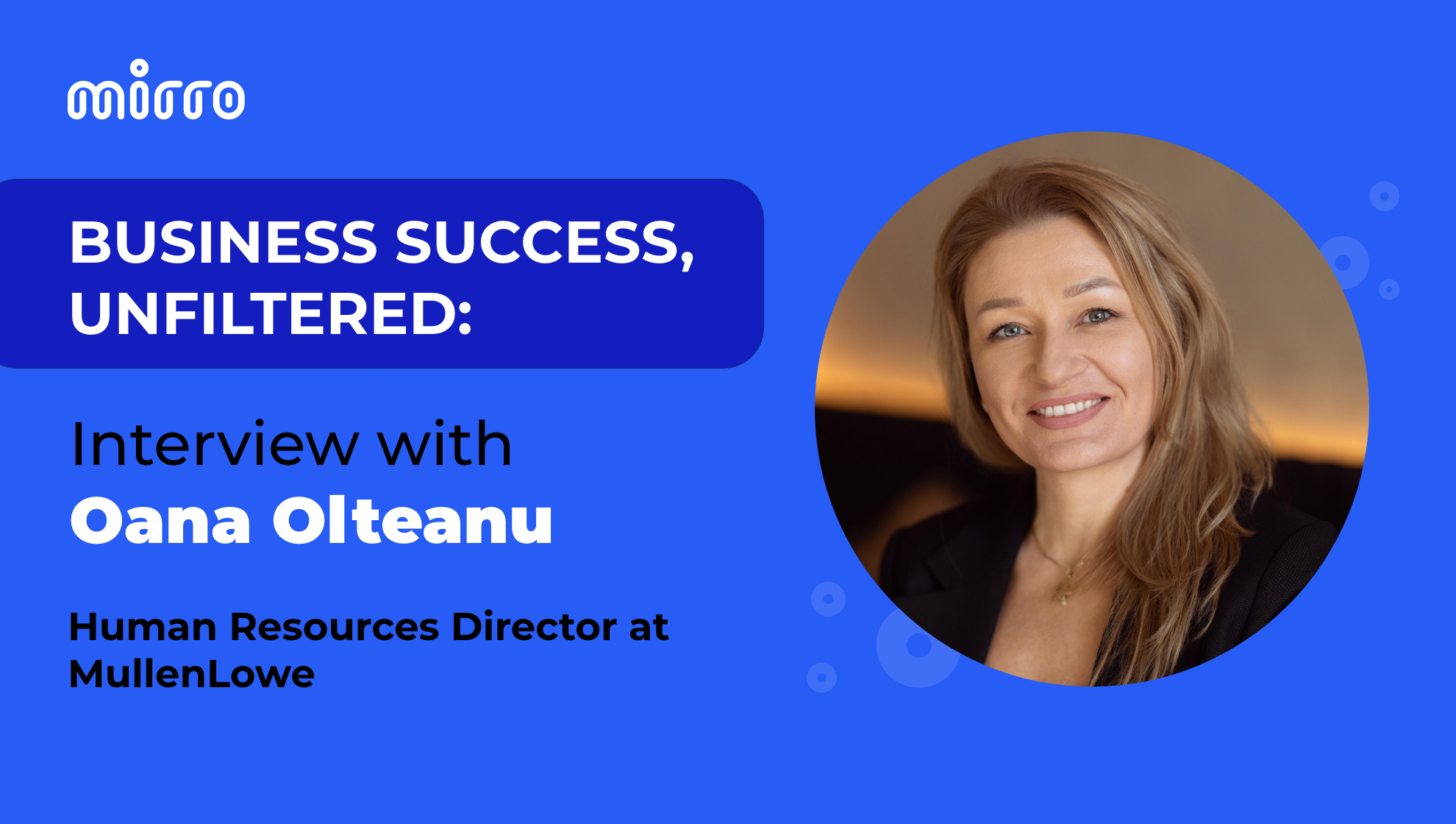
Over about two years, their People Operations team quietly turned Mirro from an HR administration tool into what Oana Olteanu, HR Director at MullenLowe Romania, calls “the place where employees interact most often with the organization."
That’s how Mirro became their employee operating system. This story is about where your employee's digital relationship with your company can begin.
The strategic decision: making one platform the single entry point
Most companies adopt HR tools to address pain points. MullenLowe Romania was no different. The early decision to implement Mirro came from very practical operational pressure.
But here's what makes their approach worth studying: they didn't stop at solving the immediate problem.
The shift happened when the organization began discussing adopting several other systems at the group level. At that point, the company began to look more closely at where employee data should fit into the system landscape. It made the most sense to position Mirro as the first step in that flow.
When you define one platform as the starting point, everything downstream becomes cleaner. This matters more than most leaders realize. HR teams commonly spend weeks per month on manual data consolidation, time that they could devote to retention strategy or people development. The decision to position Mirro as the first step in the data flow wasn't primarily a technology decision. It was a clarity decision.
The layered adoption strategy: a masterclass in change management
One of the biggest risks with HR tools is simple: people don’t use them. Here's the part that any organization that's ever rolled out a new platform needs to hear: adoption doesn't happen at launch. It happens after trust.
MullenLowe Romania didn't try to activate every feature in month one. They didn't ask employees to update their OKRs, complete performance reviews, and learn a new internal comm tool simultaneously. They started with what everyone already needed
This thinking model is strategic. Leave management doesn't sound exciting. But it's universal. Every employee, regardless of seniority, level, or department, needs to request time off. When the platform works well for something that simple, people remember it exists. They build a habit. They trust it.
Once Mirro was already part of everyday organizational interactions, it became natural to bring performance conversations into the same space. And this is the insight most change management playbooks miss.
“The goal was not to introduce a new process but to move an existing one into a space that offers more transparency and easier access to information for both employees and managers," said Oana Olteanu, HR Director at MullenLowe Romania.
From there, MullenLowe Romania expanded into structured performance management and support for internal comms and cultural initiatives through updates, announcements, and moments that connect colleagues across the organization.

When clean data becomes a competitive advantage
There's a concept in systems architecture called a source of truth. It means one place where data is authoritative, and everything else defers to it. Most HR departments don't have one.
They have a payroll system, a performance tool, a leave tracker, a few spreadsheets, and maybe a shared Drive folder that nobody remembers to update. When something changes, a name, a role, or a team, someone has to notify every system separately. And something always gets missed.
MullenLowe Romania built its source of truth intentionally.
When your employee data is clean, consistent, and centralized, every downstream decision gets better automatically. Allocating resources becomes more accurate because the team structure is up to date. Budget conversations get easier because headcount data is reliable. Resourcing decisions become faster because availability is visible.
Today, Mirro connects with Microsoft 365, project management tools, and other operational platforms at MullenLowe Romania. Because employee data originates in Mirro, those integrations stay accurate. The HR team doesn't chase updates, while the IT team doesn't manage data conflicts. And the organization doesn't make decisions based on information that's six weeks old.
“Strategically, this approach creates much better visibility around how teams are organized and how resources are allocated across projects. Operationally, it reduces the amount of manual coordination that used to be needed between departments whenever employee information changed,” declared Oana Olteanu, HR Director at MullenLowe Romania.
When HR data finally makes it to the leadership table
One of the most common frustrations HR directors share is this: I know what's happening with our people, but I can't prove it quickly enough to matter.
By the time someone from HR manually compiles a report from three different sources, they have already decided whether it was meant to inform or to go with gut instinct because that was faster.
At MullenLowe Romania, a very specific situation illustrated how this changes when your HR platform also serves as your operational system.
When the organization needed to adjust its hybrid work model, that data was already there. Leadership didn't need to wait for an HR report. They didn't need to ask each department manager to submit a summary. They could see how work was actually being organized, across the whole company, in real time.
“The transition itself was not necessarily an easy one for employees, as changes to working patterns can naturally come with some hesitation. However, having clear data and transparency around how work was being planned helped leadership make decisions more quickly and communicate them with a clearer understanding of the operational reality,” said Oana.
This is the C-level argument for rethinking HR platforms. When your people system is also your operational system, the insights don't stay inside the HR function. They flow upward, into strategy, resourcing, and leadership conversations that used to rely on instinct.
If you want to build your own employee operating system, start here
The MullenLowe Romania story isn't replicable in a quarter. But the thinking behind it is. Here's a practical starting point.
- Audit where your employee data actually lives today. Count the systems. Count the manual steps between them.
- Pick one process that every employee touches and ensure it works perfectly on your chosen platform before expanding.
- Define your source of truth before your next tool integration, not after. Decide upfront which system owns new employee data.
- Resist the urge to activate all features at launch. Earn adoption with usefulness, not mandate.
- Build a dashboard that leadership can read without an HR translation. If they need you to explain the data, it's not accessible enough.
- Give it time. Two years is not a failure. It's what sustainable adoption actually looks like.
Want to see what this looks like in practice?
If you're an HR leader thinking about consolidating tools, rethinking your data architecture, or simply trying to get leadership to take people data seriously, we'd love to show you how Mirro fits into that picture.
Not with a feature list. With your actual use case. Book a demo and let's map out what a single entry point could look like for your organization.