
SECTION


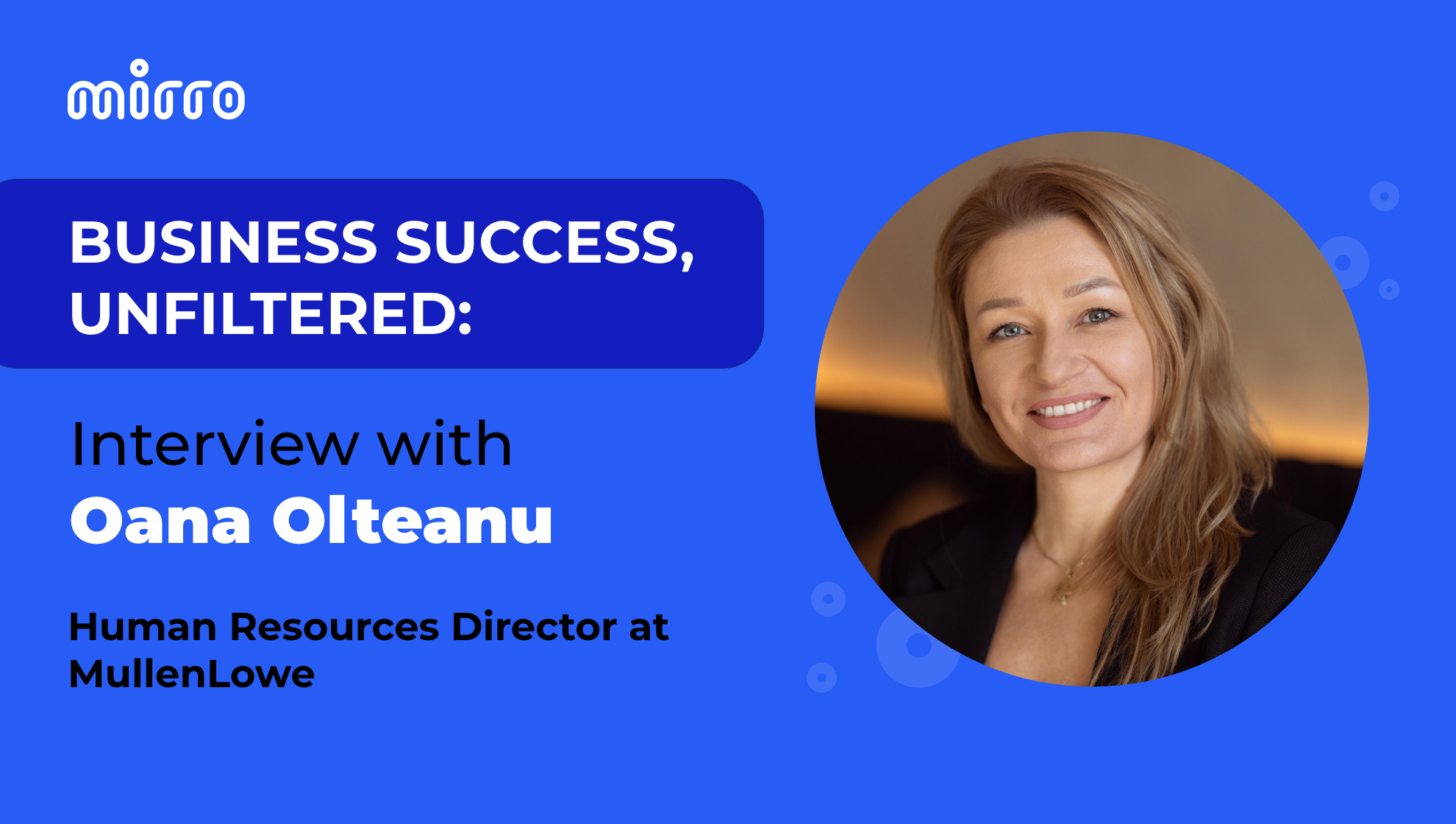
Business Success, Unfiltered: Interview with Oana Olteanu, HR Director at Lowe Group Romania
 Add a button link here


Listen to this article:
The HR function is rarely perceived as a strategic business partner. In reality, HR is a cornerstone for successful businesses. HR defines what “good performance” actually means (and keeps redefining it), acts as an early warning system for misalignment, and builds the layer that connects leadership to teams.
In this candid interview with Oana Olteanu, HR Director at Lowe Group Romania, we go beyond the usual HR topics and get into the harder questions: what breaks as organizations grow, why strategy often gets lost on its way to teams, and what it really takes for HR to prove its value at the leadership table.
Q: Oana, you’ve been an HR director for many years. With organizations changing faster today (due to growth, new technologies like AI, and more distributed teams), what has become harder for HR leaders to keep clear within companies: priorities, processes, performance expectations, alignment, or something else?
Oana: From my perspective, one of the areas that has become harder for HR leaders to keep clear is performance expectations.
In industries like advertising, where creativity, technology, and client expectations evolve very quickly, the definition of strong performance is constantly shifting. New tools, especially AI, are changing not only how we work but also what clients expect from agencies in terms of speed, efficiency, and innovation. In agency environments, where timelines are short and teams are multidisciplinary, clarity around performance becomes even more important.
For HR leaders, the challenge is to continuously redefine what good performance looks like and help teams adapt, while still maintaining alignment and protecting a strong creative culture. It’s no longer about setting expectations once a year but about constantly recalibrating them as the industry evolves.
Q: You mentioned this constant recalibration of performance expectations. When things shift that often, especially in an advertising agency, I imagine HR has to rely on early signals to stay ahead of misalignment. What signals do you personally pay attention to when you're trying to understand whether the company is aligned or starting to drift?
Oana: Very often, the first place I look is the dynamic within the leadership team. Alignment in an organization usually starts there. The way leaders interact, how consistent they are in the messages they send, and how they make decisions together tend to cascade very quickly through the rest of the organization. If the leadership team is aligned, that clarity is usually reflected in how teams collaborate, how priorities are understood, and how decisions are made.
When there are misalignments at the top, you start to see subtle signals across the organization: mixed priorities, slower decision-making, or teams interpreting the strategy differently. So, for me, paying attention to leadership dynamics is one of the earliest indicators of whether the organization is aligned or starting to drift.
Q: Very important point. Alignment always starts at the top. However, there are situations in which leadership is aligned, but companies still struggle to maintain that clarity. Where do you usually see things breaking down as strategy moves from leadership to teams?
Oana: Very often, breakdowns don’t happen because the strategy isn’t communicated clearly. It happens when teams start translating that strategy into everyday decisions and priorities. At that point, different organizational values can sometimes come into tension. For example, speed versus quality, innovation versus consistency, or autonomy versus alignment. This is actually a normal and healthy dynamic in organizations. What really matters is how those tensions are clarified. Leaders need to make explicit where the boundaries are and how those values should be balanced in practice.
From an HR perspective, our role is to help create that clarity and support leaders in navigating those moments consistently. When leaders repeatedly make decisions that show how values are applied in real situations, those behaviors start to rebalance and reinforce the culture across the organization. Culture spreads through repeated leadership behavior in moments where values need to be interpreted.
Q: From an HR perspective, how important is the manager layer in translating strategy into everyday work? Where do you see managers struggle most when trying to make that connection for their teams?
Oana: The manager layer is absolutely critical, because managers are the ones who translate strategy into everyday priorities and decisions for their teams. In most organizations, strategy is usually quite clear at the leadership level. But for teams, what really matters is how that strategy shows up in their daily work: what to prioritize, how to balance speed and quality, how to make trade-offs when projects move fast.
This is where managers often struggle the most: turning strategic direction into practical guidance that teams can apply in real situations. In agency environments, where teams are multidisciplinary and timelines are often tight, this translation becomes even more important. Managers need to constantly connect the bigger strategic direction with the realities of client work and project delivery.
From an HR perspective, supporting managers in this translation role is essential through clarity, coaching, and leadership development because they are the layer that ultimately makes strategy real for the organization.
Q: HR leaders are often asked to bring clarity and structure, even while things are still evolving inside the organization. How do you balance the need for structure with the reality that some things simply aren't settled yet, especially in such a dynamic industry as advertising?
Oana: In the advertising industry, culture is naturally very flexible and creative. That’s part of the DNA of how agencies operate. Creativity needs space, experimentation, and a certain level of freedom. At the same time, structure is essential for direction, speed, and efficiency, especially when teams are working under tight timelines and complex client expectations.
From an HR perspective, the goal is not to reduce flexibility but to provide enough structure so that creativity can actually translate into results. Clear priorities, roles, and decision-making frameworks help teams move faster and stay aligned without limiting their ability to experiment and innovate. Balance comes from protecting the organization's creative and flexible culture while putting in place structures that help that creativity scale and deliver impact.
Q: I love the idea that even creativity needs some structure. When you started building more structured people processes at Lowe Group Romania, how did you manage to get leadership buy-in for HR initiatives and HR tech?
Oana: When we started introducing more structured people processes at Lowe Group Romania, the conversation with leadership was not really about HR tools. It was about how we can strengthen our organizational culture and create more transparency across the group.
We wanted to create a space where people, processes, feedback, and internal communication could live in one place, making collaboration across our agencies easier and helping us better leverage each team's unique strengths. Mirro supported that vision on three important levels.
First, the operational layer: electronic employee files and digital document signing. This became especially important in a hybrid work environment. It simplified administrative processes, reduced paper consumption, and gave employees instant access to their documents.
Second, the performance and feedback layer: we integrated performance reviews and continuous feedback in a more modern and transparent way, helping teams have clearer conversations about growth and expectations.
And third, the culture and communication layer: moments that strengthen culture (like birthdays, work anniversaries, or internal events) become visible to everyone in one place, giving colleagues the opportunity to interact, react, and stay connected across the group.
What helped secure leadership buy-in was showing that this wasn’t just an HR initiative but a platform that supports culture, transparency, and collaboration across the entire organization.
Q: You framed it as something bigger than HR, around transparency and collaboration. Once everything was centralized like that, what changed first in how the organization actually operated?
Oana: One of the first operational changes we noticed was a significant increase in the HR team's efficiency. Many administrative tasks that used to take time, such as managing documents, approvals, and employee records, became much faster once everything was centralized. In fact, the time saved on administrative work was noticeable from the very first weeks.
Another important change was increased visibility into how teams allocate their time between office and remote work. Having that information in one place helped us better coordinate operational activities and plan collaboration moments more effectively.
And finally, when we ran our first structured feedback and performance review process through Mirro, we saw much greater consistency. Both in how performance was evaluated and in the quality of conversations between managers and team members. It helped create clearer expectations and also strengthened working relationships within teams.
Q: Most HR leaders we talk to say they can’t prove HR’s ROI to their CEO. Can you share how you do it?
Oana: I think one of the reasons HR sometimes struggles to prove ROI is because we try to measure our impact only through traditional HR metrics. In reality, HR’s value becomes clear when you see how people processes drive real business results: improving efficiency, speeding up decisions, strengthening teamwork, and helping the company scale smoothly.
For example, when we centralized our HR processes and introduced tools like Mirro, we immediately saw operational efficiencies for the HR team but also better visibility, more consistent performance conversations, and stronger alignment across the group. So the ROI doesn’t come only from cost savings but also from enabling the organization to work more clearly and efficiently.
In my experience, when HR initiatives improve clarity, transparency, and alignment, the impact becomes very visible at the leadership level because those factors directly influence how fast and effectively the organization can move.
Q: You’re describing improvements not just in efficiency, but also in visibility and consistency. When you take that to a CEO, how do you translate those kinds of outcomes into something that clearly shows HR’s ROI?
Oana: Data plays a very important role in making the impact of HR more visible. One of the biggest advantages we saw after implementing Mirro was the access to clear, centralized dashboards. In the past, many of these insights existed, but they were scattered across different sources and required time to consolidate into an up-to-date picture. Now the data is available almost immediately, making it much easier to understand patterns in performance, feedback, or engagement.
This visibility helps us have more informed conversations with leadership, because we can connect people-related insights with what is happening in the organization. It also allows us to move from intuition to evidence when discussing topics like performance, development, or team dynamics. Having that data readily available makes HR conversations much more strategic and grounded in reality.
Q: Looking ahead, what role do you think HR systems and integrations will play in helping organizations make better decisions and stay aligned?
Oana: Looking ahead, I believe HR systems will play an increasingly important role in organizations' decision-making infrastructure. But I also think the next step is for these systems to evolve beyond simply responding to operational needs. Today, many platforms help us manage processes and gather data, which is already very valuable.
What I see as the real opportunity is for HR systems to become much more active in supporting growth and development, helping organizations better understand their people’s strengths, how teams collaborate, and where new capabilities can emerge. In creative industries like advertising, where talent and collaboration are the real competitive advantage, these systems could help organizations connect people, projects, and skills more effectively. So the future is not only about better data but also about creating ecosystems that help organizations unlock the potential of their people and continuously develop new capabilities.
Why this conversation matters
Here are a few ideas worth sleeping on from this insightful conversation:
- Performance is no longer a fixed standard, but a moving mechanism. HR’s role is to keep recalibrating expectations, so teams stay relevant, not just consistent.
- Strategy doesn’t break at the communication level; it breaks when teams try to apply it. The real work happens in everyday trade-offs, and HR helps leaders and managers make those trade-offs clear and consistent.
- HR’s impact shows up in how the business runs. You won’t always see it in traditional HR metrics. You see it in faster decisions, better collaboration, and an organization that doesn’t lose clarity as it grows.
As we continue this series, we'll explore more stories from HR and business leaders who are committed to powering a people-first strategy. Keep an eye on us to be the first to read their experiences!