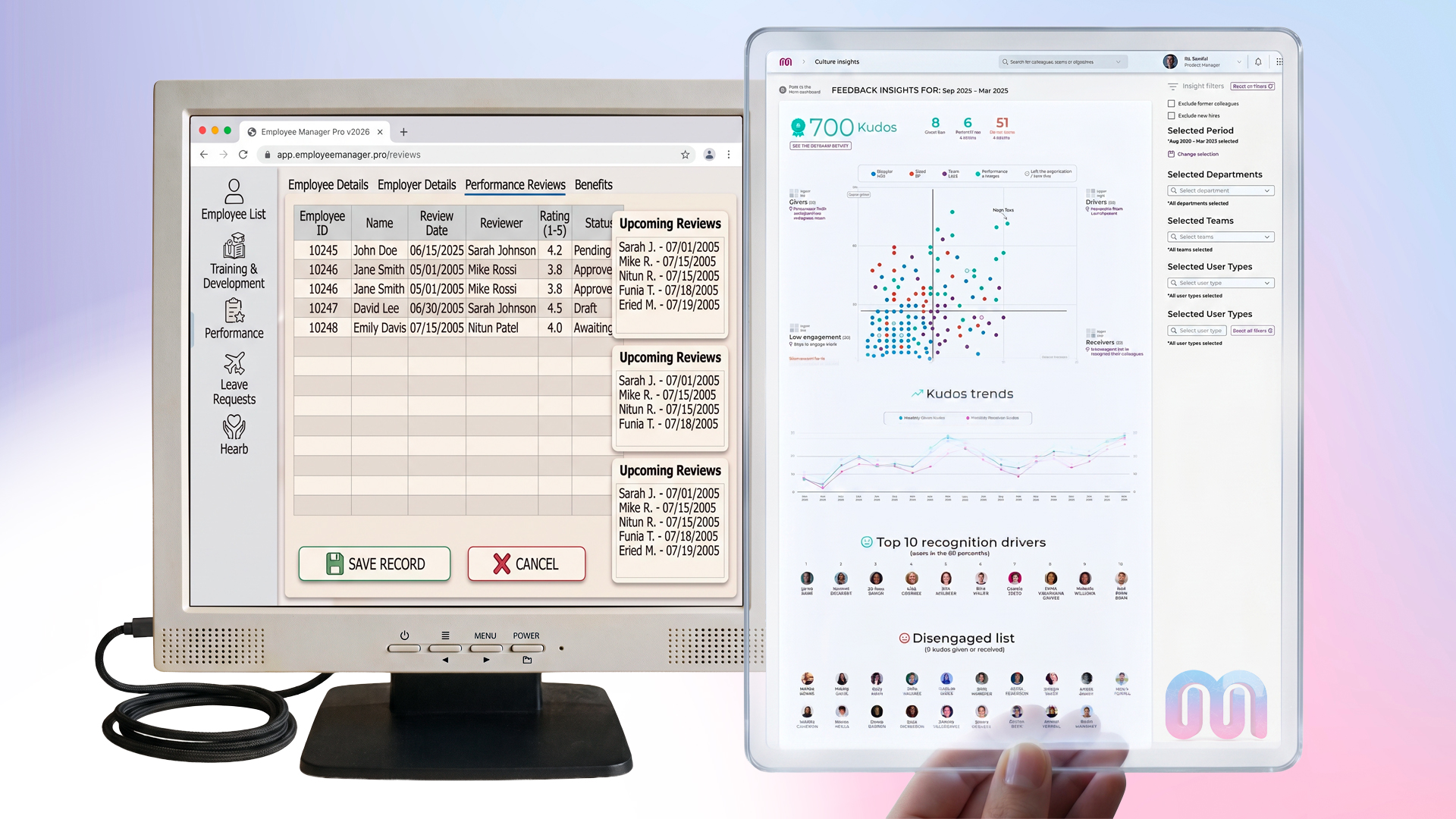
Picture the last compensation decision your company made. Somewhere there's a record of how that person performed: a review, a few objectives, a note from their manager. Somewhere else, in a different system or spreadsheet, sits the financial side: their place in the salary structure, what the raise does to the team's budget, or the cost they add to the plan. Those two pictures rarely sit together, and in some cases, they never meet.
The gap is so normal that most people stop noticing it. Performance lives in one tool. The financial picture of the workforce, compensation budgets, salary ranges, and cost planning live in another. People and money decisions get made on opposite sides of a wall.
The usual prescription is to knock down the wall with an integration project: wire the HR system to the finance system and sync the data between them. This article makes a different case. Connecting HR and financial management is a design choice, not a six-month program, and the simplest route to it runs through performance.
Two worlds that rarely meet
Start with what the split costs. When compensation is decided without the performance picture in front of you, the decision is half-blind. When the financial picture is built without performance, the budget is a guess.
You can hear it in how companies talk about their own pay processes. One team admitted to "salary increases performed incorrectly," which is budget going out the door for reasons no one can reconstruct later. Others can't even reach a decision: "It's hard to budget because we don't understand salary differences," and "I don't know if employees are fairly paid because I don't have access to data."
That isn't a failure of effort. It's what happens when managers know how employees performed, and the people who own the numbers are looking at different screens. Bridging that distance by hand, every planning cycle, is slow and easy to get wrong.
Imagine the dots connected
Now, picture the opposite: one view where performance and financial numbers sit together.
A compensation review opens, and the person's recent performance is right there: their objectives, their last few reviews, the recognition they've earned, and the feedback they’ve received. The number you're about to set has a story attached to it.
A dashboard shows where the compensation budget actually goes, mapped against contribution rather than headcount alone. You can see where strong performers sit in their range and where pay and delivery have drifted apart.
Salary structures and equity views sit next to who is doing the work, so a pay decision lands in context. Workforce-cost and retention signals show up in the same place, so a budget pressure building three months out is visible now, not at the next forecast.
This is what happens when people and money data stop living in separate systems. The question is how you get there.
Why the usual route is a detour
The standard answer is to buy an integration. Wire the HR system to the finance stack, sync the records, and let the two talk. For a large enterprise with its own analysts and a multi-year roadmap, that can be the right move.
For most companies, however, it's a detour. The advice is written for enterprises and often by the vendor selling the integration. It assumes time and budget that smaller teams have usually already spent. The honest verdict shows up in how buyers describe past purchases: "We've bought a system for so long and still don't use it."
There's a quieter problem, too. A bridge between two systems is not one connected picture. You still maintain both sides and reconcile them at every cycle.
Here's the shift. The connection you want comes from starting with performance management and letting the financial picture follow. Wiring two systems together doesn't create that on its own.
When a system is built performance-first, compensation and cost numbers sit atop something meaningful. A pay figure next to a documented review reads differently from a figure on its own. Objectives show what a role delivered. Recognition shows who carried the team. Compensation stops being an abstract line in the budget and becomes a number with context.
That context flows into planning, too. When you can see the contribution next to the cost, workforce-cost forecasts rest on more than headcount and last year's figure. The dots connect by design because performance is what the financial picture hangs from. No integration project required.
Where Mirro fits
This is the picture Mirro is built around. Performance reviews, objectives, recognition, and engagement live alongside salary ranges, pay-equity analytics, and compensation dashboards, in one view. The performance and the financial picture are together because the system was designed that way, not bridged later.
Mirro is built for teams without a department to spare. Administrators set up their own review cycles and compensation views without waiting on support, which gets the system live in weeks and saves hours on every process. The result is the connected picture above, reached without an integration program and without hiring a comp specialist to run it.
The aim is simple. Put performance and the financial picture in the same view, from day one, so the decisions that depend on both stop being half-blind. See what it looks like when performance and the financial picture live in one view: try Mirro.
Frequently Asked Questions