Organizations often define bold objectives, yet struggle to translate them into measurable performance, aligned teams, and informed executive decisions. This is where performance management evolves beyond HR mechanics and becomes something far more powerful: a strategy-and-performance command center.
At its best, performance management correlates company strategy, OKRs, cross-team dependencies, milestone progress, engagement, feedback, and reviews, mapping people's inputs directly to business objectives.
But building such an operating model is not simple. Many organizations face perception risks, and others struggle to demonstrate ROI early enough to convince CEOs and CFOs of its strategic value.
At Leviatan Group, performance management is not an isolated system. It is embedded in the company’s DNA.
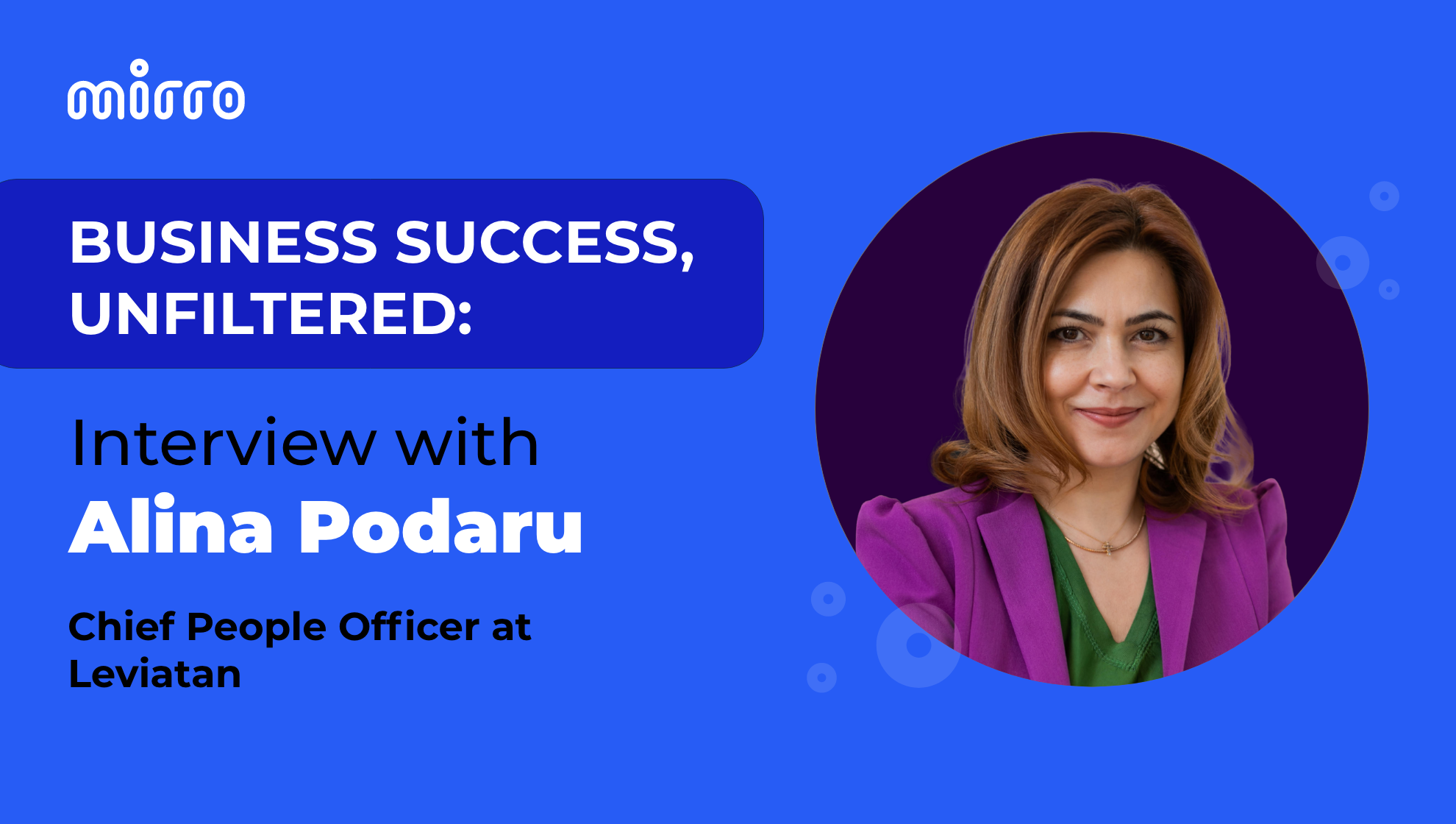
We spoke with Alina Podaru, Chief People & Culture Officer at Leviatan Group, about what it truly takes to lead performance with clarity, transparency, and business impact, and how Mirro became part of their transformation journey.
Q: Thank you so much for joining us, Alina! Leviatan Group is recognized as one of Romania’s top employers in 2026, a recognition that doesn't happen by chance. What makes your company stand out, and how do you plan to sustain this reputation in a highly competitive talent market?
Alina: To begin with, what truly sets us apart is our commitment to placing people at the heart of everything we do. We don’t just construct buildings; we build solid relationships, careers, and communities. We strive to be a place where professional growth goes hand in hand with personal development. To maintain this reputation, we rely on radical honesty and keep our promises, regardless of the situation. We integrate all our people strategies into a coherent ecosystem that supports both our team's growth and our business strategy, maintaining a clear, coherent structure where the "open-door policy" is a reality, not just a corporate phrase.
Q: You mentioned integrating people strategies into a coherent ecosystem that supports both growth and business objectives. In that context, where does performance management fit? And how do you ensure it goes beyond simple evaluation to truly drive continuous growth for your people?
Alina: For us, performance management is about growth, not just measurement. We’ve redefined the evaluation by creating a real space for continuous dialogues focused on support and recognition. We look beyond raw numbers; we see the impact, the learning process, and the specific context of each colleague. It is a space where we allow ourselves to be vulnerable and accept mistakes as essential lessons. Ultimately, it’s about how we help each other improve, aligning individual ambitions with the company’s vision.
Q: This is what performance management is all about: real, sustainable growth. Designing a thoughtful performance framework is hard on its own, but keeping it relevant as the business evolves is even harder. So, what are the key elements that help you maintain a performance management process that is not only well-designed but also adaptive to business changes and diverse employee needs?
Alina: Multi-directional communication is the backbone of our process. We have long moved past the one-way dimension of performance management; today, transparency and the absence of communication silos are vital. Flexibility and simplicity are also crucial to remain relevant for both our colleagues on construction sites and those in the offices. In this regard, constant check-ins and CFR (Conversations, Feedback, Recognition) sessions are the tools that keep us all on a clear path of performance and evolution.
Q: You speak about alignment between individual ambition and company vision, something many organizations aspire to but struggle to operationalize. How do you ensure your teams, from field workers to executives, feel aligned and connected to Leviatan’s goals?
Alina: The answer lies in alignment through communication. For us, OKRs are not just beautiful phrases written in a platform; they are the "lighthouse" that guides us. It all starts with communicating the organization’s strategic OKRs, which then become the focal point for every team and colleague. Through structured discussions, everyone understands exactly how their work contributes to reaching that lighthouse. When this network of OKRs takes shape, everyone realizes that the organization is a living system evolving through each individual's contribution.
Q: As an employer with frontline, field, and office employees, how do you keep everyone equally engaged, connected, and part of the same culture?
Alina: We live our values; we don’t just display them. Although physical distance or the site context can be challenging, we never compromise on our shared rituals and the annual events that bring us all together. Technology is a powerful ally—we are always just a few clicks away, ensuring no situation is left unaddressed. Above all, we work daily on building a culture of open feedback, transforming geographical distance into a mere logistical detail.
Q: Some companies define values but struggle to embed them. How do you make sure Leviatan’s values are truly lived by employees across all levels and not just written on paper?
Alina: Our values become visible through our leaders' personal examples and the way we interact with one another. We actively celebrate them through public recognition and creative initiatives born within our team. For instance, we have the campaigns of "Organizatorul de Ganduri" for team activities and even our own board game, "Tandem"—products that were born organically from our desire to translate our values into concrete, memorable experiences.
Q: As your organization evolved and your performance processes matured, you decided to implement Mirro. What prompted that step, and how has it transformed the way you handle feedback, recognition, and transparency in performance discussions?
Alina: Mirro arrived as a natural solution to the organizational transformation project we started over three years ago. It brought much-needed transparency and turned recognition from an occasional gesture into a daily practice. It is surprising and heartening to see how colleagues naturally use the platform to share recognition for each other’s work (kudos) or even request feedback. It has provided a digital "home" for our processes, making feedback flow naturally and ensuring every person feels seen and appreciated.
Q: As Leviatan grows, how do you balance scaling the business with maintaining the same people-centric culture that defines you today?
Alina: The secret is conscious alignment. In a challenging environment like the one we’ve faced in recent years, we’ve learned that people respond with openness when they know the strategic direction and what is expected of them. We maintain this balance by being honest about challenges and offering, in return, empathy, and real development opportunities, while also encouraging autonomy and collaboration. When people feel they are part of the solution, the business grows sustainably alongside them.
Q: You’ve described data as an ally to instinct and empathy, which is a powerful perspective. We speak with many leaders, and we know that one of the biggest struggles is making informed, timely decisions with accurate workforce data. How do you leverage workforce data to support strategic decision-making?
Alina: In the People & Culture team, data is the ally that complements instinct and empathy. Data provides us with clarity and rhythm, helping us know when to accelerate, pause, or pivot. We combine metrics with care and responsibility, turning raw data into a "winning" strategy that sustains the organization's vitality and enables well-founded decisions.
Q: Looking ahead, what shifts in employee expectations from the workplace do you anticipate, and how is Leviatan preparing to meet these while staying true to its people-first philosophy?
Alina: We live in times where adaptability is no longer a "fancy name" but a core policy. We know employees seek stability, and we offer it by "embracing change." We prepare by cultivating critical thinking, curiosity, and openness to technology. Our promise is to grow together. We provide meaning and belonging within a community that doesn't fear the future but actively builds it through autonomy and continuous learning.
From performance framework to strategic command center
Leviatan’s journey shows that when performance management is designed as a living ecosystem (supported by the right consultancy, technology, and cultural intent), it bridges the strategy-to-performance gap. And ultimately, that is what separates organizations that plan from organizations that lead the market.




 Add a button link here