




Listen to this article:
Research has identified 13 behaviors that reliably precede a resignation. Every one of them depends on a manager noticing a change. This page covers what the research actually found, why it misses a whole population, and the five lists that surface them.
What are the signs an employee is about to quit?
Most answers to this question are lists someone assembled from experience. There's a better source, and it starts by asking the people who already left.
Research published in the Journal of Management did exactly that. The researchers asked employees who had resigned, and the managers who watched them go, what changed in the months before. That produced 58 candidate behaviors, which factor analysis cut to 13. They call them pre-quitting behaviors, and the premise is that employees on their way out leak them without meaning to.
Then the test that matters: managers rated their employees on all 13, and thirteen months later the researchers checked who had actually left.
The 13 pre-quitting behaviors
SHRM published the full list if you want each item verbatim.
How strong is the effect, really?
The behaviors did predict voluntary turnover, over and above the established predictors. But look at the size of the effect before building a process on it. Using the study's own worked example, an employee with a 4.35% chance of leaving moves to 5.34% when their score rises by a full point, which is about one percentage point. The effect is real, but it isn't the searchlight the headline number suggests.
It's worth knowing where it was measured, too. The predictive test followed 193 employees at US funeral homes, average age 45, average tenure nearly ten years, with a base turnover rate of 8.7%. A useful finding, from a workforce that looks nothing like most of the companies now citing it.
So: a genuinely useful list, and if you manage a small team you can act on it today. Just don't mistake it for a system.
Why do those signs miss the people you most need to catch?
Read the 13 behaviors again and notice what every one has in common. Each is phrased as a change from the usual. Less like a team player than usual. Leaving early more frequently than usual.
That phrasing is the instrument itself. Each item asks a manager to compare someone against a baseline, and that baseline exists only in the manager's head, built up by paying attention over time.
Which means the method works exactly as well as the attention behind it. For a manager with six direct reports and a weekly one-to-one habit, it works well. For a manager with nineteen reports across two locations, it works for the four people they speak to most.
The Observation Gap is the group of employees whose disengagement no manager is positioned to notice, because noticing depends on a baseline that only close attention creates. Behavior-based warning lists never reach them, because there's no observed change to record. What they leave in your HR system is an absence rather than an event, and an absence is something you can query.
One more thing worth knowing about the research. The data was collected in early 2014, before distributed work was normal, so "left early from work more frequently" meant something concrete in an office and means very little now.
Why can't an engagement survey close the gap?
Because anonymity is a setting you choose per survey, and either choice closes a different door.
Run it anonymously and you get candid answers, but the identifying fields are stripped along with any per-person filtering, so you can't tell whose answers they are. Run it identified and you keep the names, but the employees furthest from the organization are the least likely to answer at all, and they're exactly the population you were trying to find.
Candor or attribution. One instrument won't give you both.
There's a harder version of this too. One HR team put it bluntly: people leave for good if you ask them to fill in more forms. Measuring disengagement by asking the disengaged carries its own cost, which is why so much effort now goes into designing surveys people will actually finish.
None of this makes employee surveys wrong. They're just not the right tool for finding whether one specific person intends to leave.
Which five lists actually show the gap?
Every one of these signals is a record of something that either happened or didn't, so the data can always be computed. The only real question is whether it sits in one place.
Worth checking your own stack before you go further. The first list exists in essentially every HR system, because every system knows who reports to whom. The other four depend on whether performance conversations, objectives and recognition live alongside the employee record or in three separate tools. Where they're scattered you can still do this, but you'll be exporting and matching rather than filtering, and it stops being an hour's work.
Where they sit together, the whole exercise takes about an hour. Most of these are flat lists rather than dashboards, so you don't need a data team. In Mirro these sit in two places: Performance Insights holds the performance lists, and the Connections cloud under Culture Insights holds the relationship views.
Start with the two that need no interpretation
Two rules that separate a signal from a mess
Control for joiners and leavers. New hires look isolated because they're new, and departing employees drag every count down. Filter both out before you read anything. In Mirro that's two checkboxes in the Insight filters panel, Exclude new hire and Exclude former colleagues, both on by default. If your system has no equivalent, do it by hand on hire and end dates before you look at anything else.
One list is noise. Two is a signal. Nobody should be flagged for appearing on a single list. A person who shows up on two or more, in the same period, in the same department, is worth a conversation. Compare people against their own cohort rather than the whole company, which is the same logic behind segmenting a workforce before you analyze it.
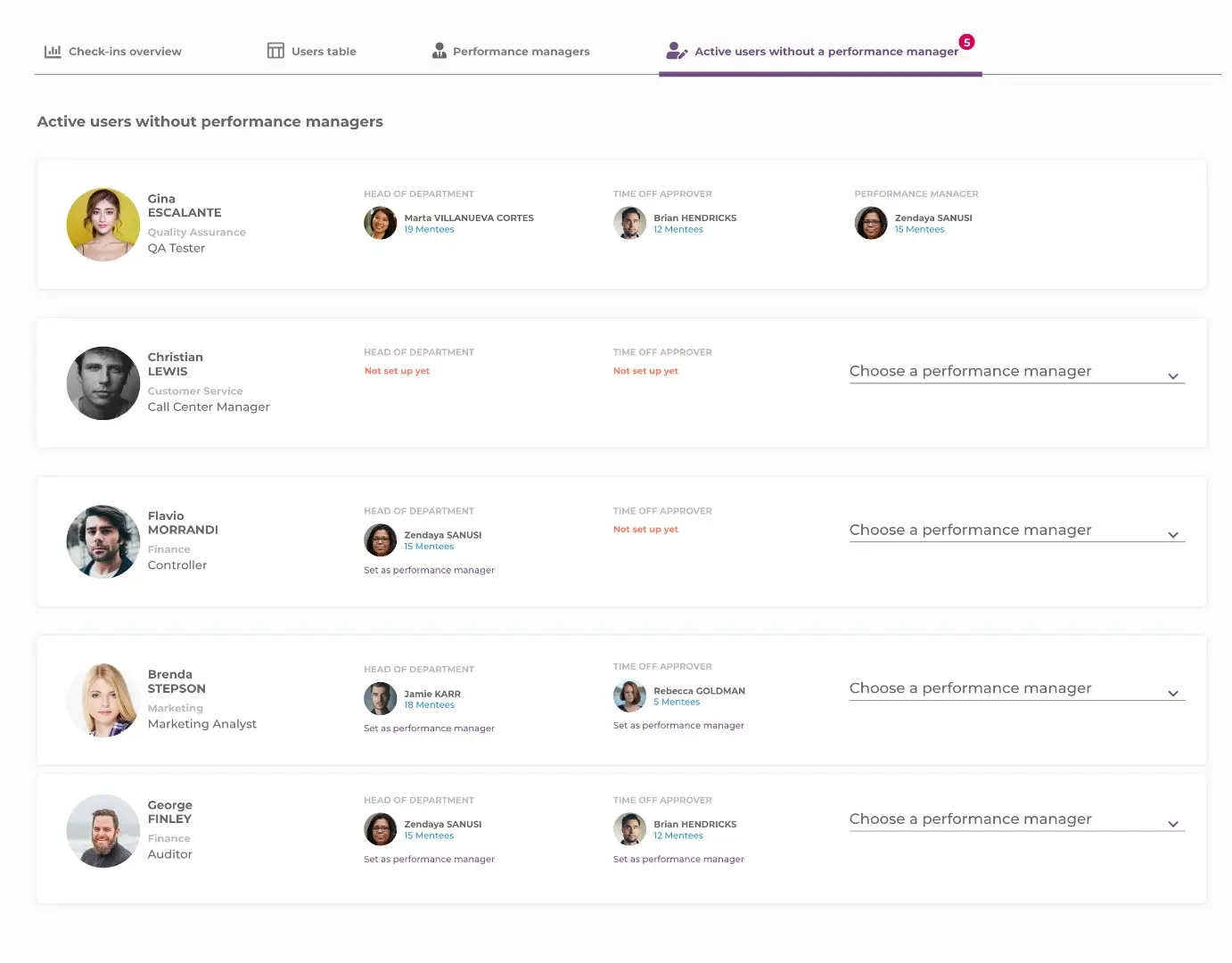
Clicking Performance Managers List in Performance Insights opens this. Active users without performance managers sits at the top, and you set a performance manager for each one from there.
"We tried this before and nothing changed"
Fair, and mostly true.
A list of disconnected people changes nothing. It's a list. Plenty of engagement tools have produced one, and turnover didn't move.
What changes the outcome is the conversation. The list only decides who you have it with, and that matters because attention is the scarce resource here, not data. A manager can't have a real conversation with everyone this quarter. They can have five, and the difference between five well-chosen conversations and five convenient ones is most of the value.
So treat them as a way of deciding who to go talk to. If you stop at the dashboard, you'll get the same result you got last time.
Can you predict who will leave?
Not reliably, and be careful with anyone who says otherwise.
A 2023 systematic review in Social Network Analysis and Mining, covering 30 studies of voluntary turnover, found that a person's position in the organization's network is not consistently associated with leaving. Peripheral people don't simply quit more. The relationship is real but conditional, and it depends on what else is true about them.
The same review points at something more useful. Turnover appears to cluster among people in similar network positions, and it's most pronounced where sentiment is already negative. It travels in patterns, from the same edges of the organization, rather than one person at a time from random places.
So the honest framing is targeting rather than prediction. Position tells you where to look; sentiment, tenure and a manager's own read tell you what you're looking at.
How do you act on this without it becoming surveillance?
The obvious version of this idea is unpleasant, so it's worth drawing the line clearly.
One category of tool infers collaboration networks by analyzing email and calendar metadata. In Europe that meets real constraints fast, from lawful basis and data minimization under GDPR to co-determination law in several member states, where introducing a monitoring system needs works council agreement first.
What's described above is different in kind. Every signal comes from something an employee did deliberately and visibly: gave feedback, received recognition, joined a team, took on an objective, had a check-in. Nothing is inferred from private communication, because nothing reads private communication.
Two guardrails, ours rather than the law's. Scope access to the people who need it. Mirro does this with access rights rather than policy: Performance Insights per Location and People Stats Access Per Location restrict Dashboard data to someone's assigned locations, and the manager list behind list 1 needs Company Performance Admin even to open. And never let this become a score attached to a person: the moment it turns into a ranking, the manager acting on it loses the trust that makes the conversation work.
What do you do in the first 30 days?
Week 3 is where this succeeds or fails, and it's worth reading up on how to run a one-to-one that isn't a status report before you start. Ask what they're working on, who they rely on, and what would make the next quarter better.
Week 4 is the one almost nobody does, and it's the only thing separating this from guesswork. People analytics reporting will show turnover over time and average length of service for the people who left; in Mirro that's the People Insights dashboard. If your list had no relationship to your leavers, the method isn't working in your context and you should stop.
Accace, a financial services firm, worked this way over a longer period and cut turnover from 29.8% to 14%. What they describe as the mechanism is habit rather than reporting: giving feedback and public recognition became routine, which is also what made the signal legible in the first place. Read the Accace story.
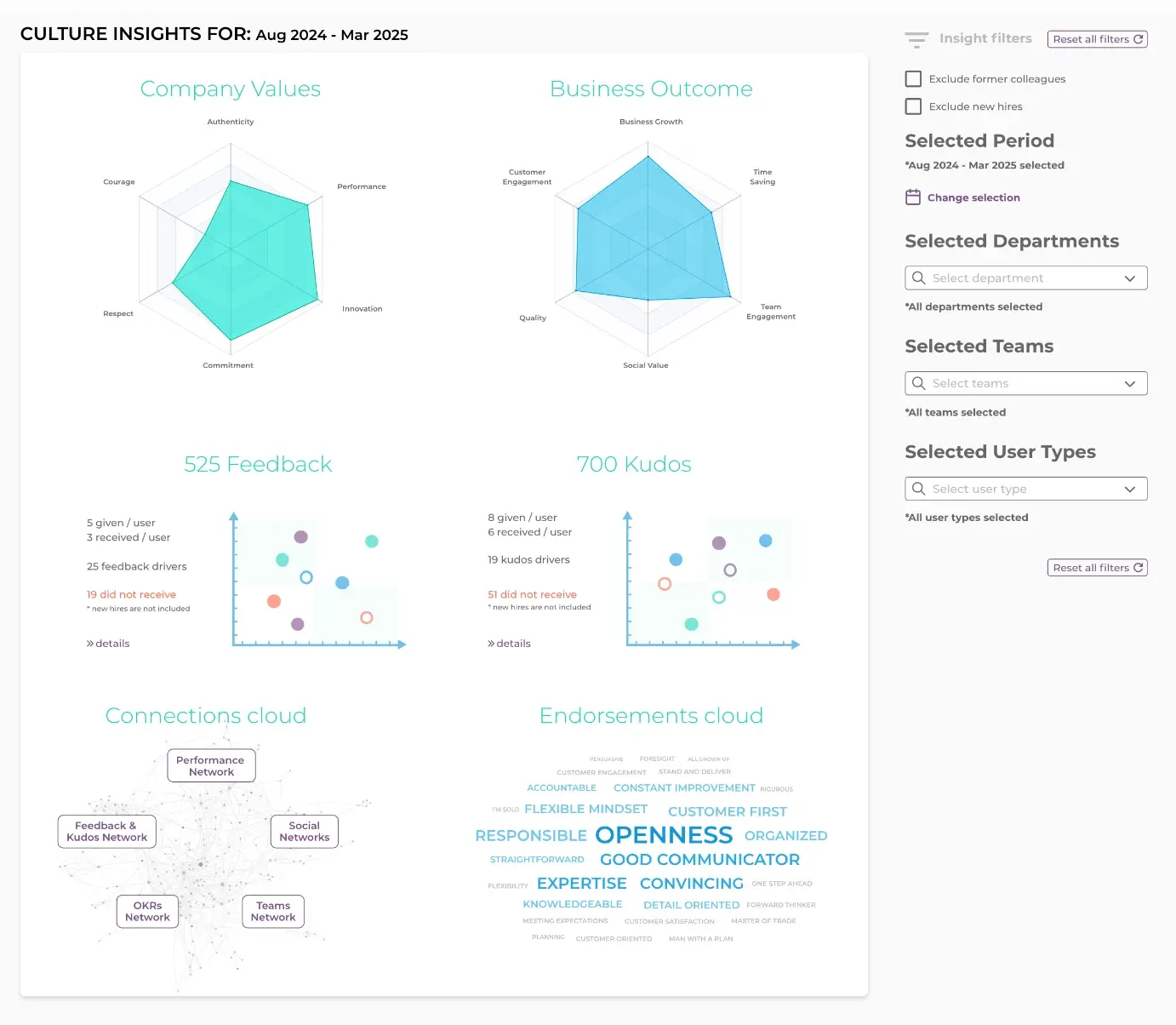
Set the period, scope to a department or team, and leave Exclude new hire and Exclude former colleagues ticked. Those two checkboxes stop the list filling up with people who just arrived or already left.
Explaining it upward
If you need a CEO or CFO to fund this, make the case in money rather than engagement. Every unplanned exit costs a replacement hire and several months of reduced output while the role refills. It also costs institutional knowledge that walks out with the person, plus some damage to your employer brand in a market where candidates compare notes. Against that, the lists cost an hour a month and the conversations cost a manager's afternoon. Put your own numbers to it with the ROI calculator.
What network graphs add
Everything above comes out as a flat list. Three of those lists sit underneath a network graph, which you can scroll straight past. The graph is what you come back for once the lists are running.
Plotted as a graph, the same data shows something lists can't: clusters. Small groups connected to each other and to nobody else, drifting at the edge of the organization. That's the pattern the turnover research points at, made visible, and it's the difference between spotting five individuals and spotting a team that has quietly detached.
The same graphs read the other way too, surfacing the people who hold a company's culture together rather than the ones drifting out of it. We covered that side separately in finding your hidden ambassadors, and documented how all five networks are built if you want the mechanics.
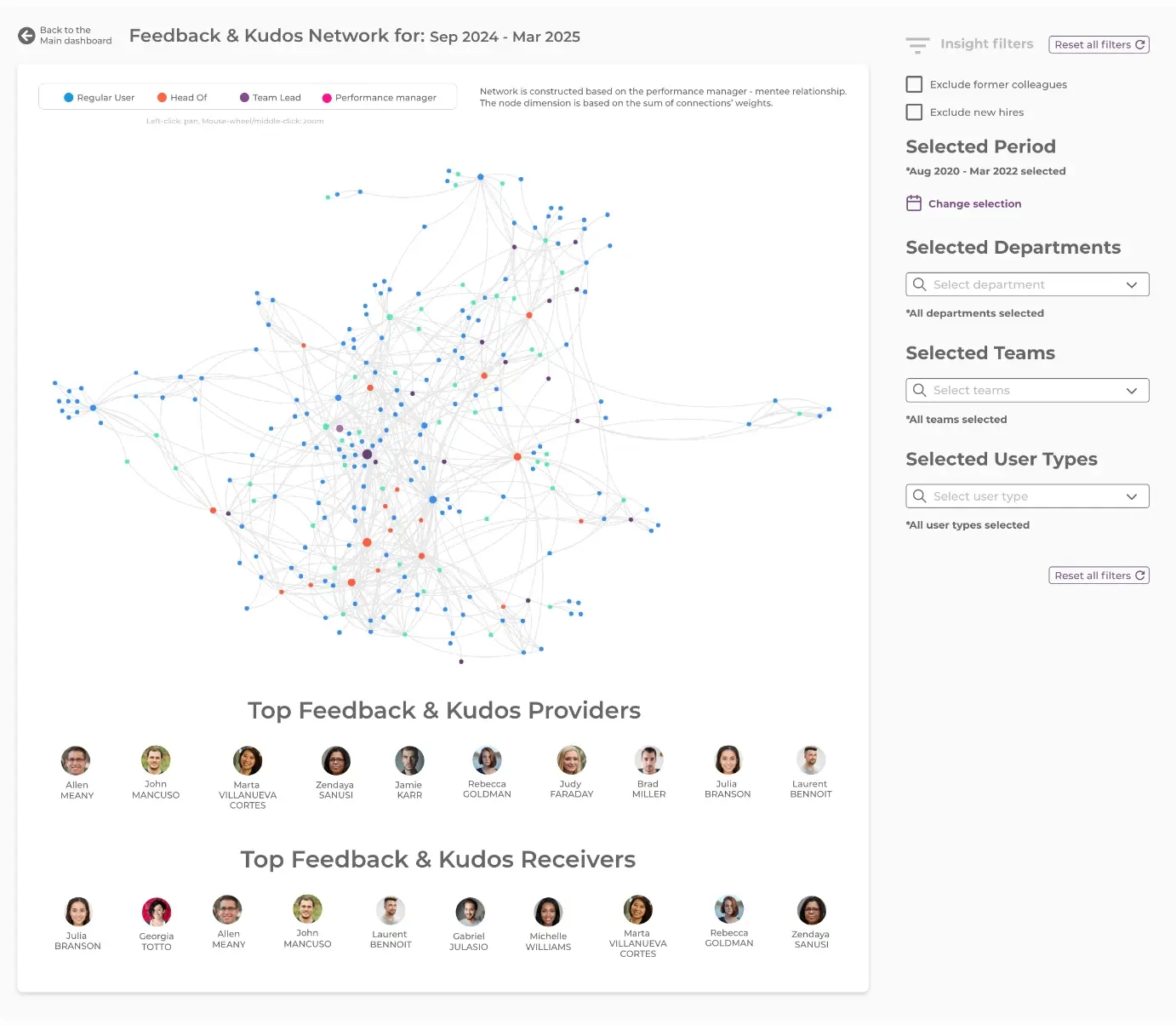
Pick a network view, then shorten the period until the graph is readable. What you're looking for is a small group connected to itself and to nothing else, out at the edge.
Not a prediction, and not a rescued employee every time. Some people on your lists will be fine. Some are already gone in their heads, and a conversation in week three won't change that.
What it buys is the chance to be early instead of surprised.
Go back to the exit interview at the top of this article, the one where someone says they'd felt disconnected for months. The months are the part you can change. Not whether people leave, but how long the drift runs before anyone says anything about it.
That gap is less a data problem than an attention problem. Where the employee record is consolidated, the evidence already exists and nobody is reading it. Attention doesn't scale, and the people who fall outside it cluster predictably: the five lists are where they collect.
You won't close that gap. You can make it considerably smaller, an hour a month at a time.
Want to see these lists on your own employee data? Book a demo.
Frequently asked questions